Let’s consider the following symmetrical position.
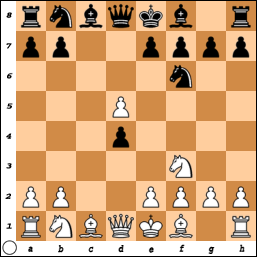
It can be reached by different move orders:
1.d4 d5 2.Nf3 Nf6 3.c4 c5 4.cxd5 cxd4
or
1.d4 d5 2.c4 c5 3.cxd5 Nf6 4.Nf3 cxd4
or
1.Nf3 d5 2.d4 c5 3.c4 cxd4 4.cxd5 Nf6
A variation that for a long time was considered dubious for Black became less and less questionable with the advent of increasingly strong engines. However, in serious tournaments Black had been reluctant to employ this setup for quite some time. But in 2024, at the Candidates Tournament in Toronto, Hikaru Nakamura surprised the young Indian talent Rameshbabu Praggnanandhaa by playing 1.d4 d5 2.Nf3 Nf6 3.c4 c5 !? 4.cxd5 cxd4 and, to many people’s surprise, not only equalized but even won the game.
I gave this unnamed variation the name Karaklajic, because a search in Mega Database 2026 showed that the Yugoslav International Master Nikola Karaklajic employed the relatively rare move 3…c5 after 1.d4 d5 2.Nf3 Nf6 3.c4 twelve (12) times, with the first game dating back to 1949. So why not?
Returning to the Candidates Tournament game in Toronto, the game continued:
5.Qxd4 Qxd5 6.Nc3 Qxd4 7.Nxd4 a6 8.g3 e5 9.Nb3 Nc6 10.Bg2 a5.
Except for Black’s last move, all of this had been seen frequently even in earlier chess eras. However, 10…a6-a5! as the main (strongest) move gained recognition only in the Stockfish era.
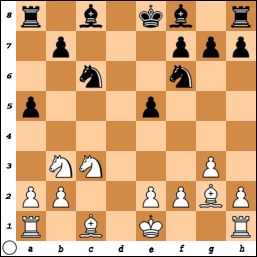
Without computer assistance, the position is not easy to defend. Black is slightly underdeveloped; the last move …a5 has both positives (activity) and negatives (the b5-square is weakened), and in general White has many options. Still, the position holds.
Let us list all noteworthy continuations for White: 11.Nb5, 11.0-0, 11.Na4, 11.Bg5, 11.Be3
11.Nb5 is the natural “test” of the c7-square, played by Praggnanandhaa in his game against Nakamura: Bb4+ 12.Bd2 Ke7 13.a3 Bxd2+ 14.Nxd2 a4 15.Nc4 Be6 16.Rc1 Ra6 17.O-O Rd8 18.Ne3 Ra5 19.Bxc6 bxc6 20.Nc3 Here, instead of 20…Bb3 21. Nb1 Ra6 with complex play in which Nakamura proved stronger, it was quite possible to play 20…Rd2 21.Rc2 Rxc2 22.Nxc2 Nd5 23.Nb4 Nxb4 24.axb4 Ra6 25.Ra1 Bb3 with a risk-free endgame for Black.
11.0-0 is the most common move according to databases: a4 12.Nd2 Be6 13.Nb5 Kd7 14.Rd1 Kc8
15.Nf3 Ra5 16.Nc3 (Matlakov,M (2651)-Nakamura,H (2802) Chess.com INT 2024). Instead of the prophylactic 16…h6 (as played in the game), 16…Bb4 was quite possible, and after 17.Ng5 – 17…Bc4 18.Bd2 Rd8 19.a3 Be7 with chances for both sides.
After 12.Nb5 (instead of 12.Nd2) Rb8 13.Nd2, it is important to begin with 13…Bg4 , and Black is fine everywhere — 14.Bf3 Bh3 15.Rd1 Rd8 (14.f3 Bc5+ 15.Kh1 Bd7, 14.Nc3 Bb4)
11.Na4 looks logical – it restrains a5-a4 and hints at the weakness of the b6-square: Bb4+ 12.Bd2 Ke7 13.Rc1 Rd8 14.Nb6 Ra6 15.Nxc8 Rxc8 16.a3 Bxd2 17.Nxd2 Rb6 18.b3 Na7 19.0-0 Nd7, and everything seems quite solid.
11.Bg5 a4 12.Nd2 a3 13.bxa3 Bxa3 14.Nb5 0-0 15.0-0 Bg4 16.Bxc6 bxc6 17.Nxa3 Rxa3 18.Nc4 Ra4 19.Nxe5 Bxe2 20.Rfc1 This was not forced but fairly logical play in Bai,J (2566)-Aryan,C (2541) Bhubaneswar 2018. Here 20…Nd5!? looks good, with sufficient counterplay for equality, for example: 21. Nxc6 f6 22.Bd2 Bf3 23.Rc5 Re8 24.a3 Re2 25.Bc3 Rc2 =
11. Be3 a4 12.Nd2 occurred in Bernadskiy,V (2530)-Bai,J (2549) Oskemen 2024. Instead of the game move 12…Bb4, 12…Be6 is probably better, with a line such as: 13.Nb5 Kd7 14.Rd1 Kc8 15.Rc1 Nd5
16.Bc5 Bxc5 17.Rxc5 Rd8 18.Nc4 Kb8 =
An untested improvement for White is 12.Nc5. сAccording to engines, complications might arise along the lines of: 12…a3 13.bxa3 Nd4 14.Bxd4 exd4 15.Nb5 Bxc5 16.Nc7+ Ke7 17.Nxa8 Bd7 18.Bxb7 Rb8 19. Bf3 Kd6 20.Rc1 Bg4 21.Bxg4 Nxg4 22.Rc7 Bxa3 23.0-0 Bxc1 24.Rxc1 Rxb2 with an equal endgame.